

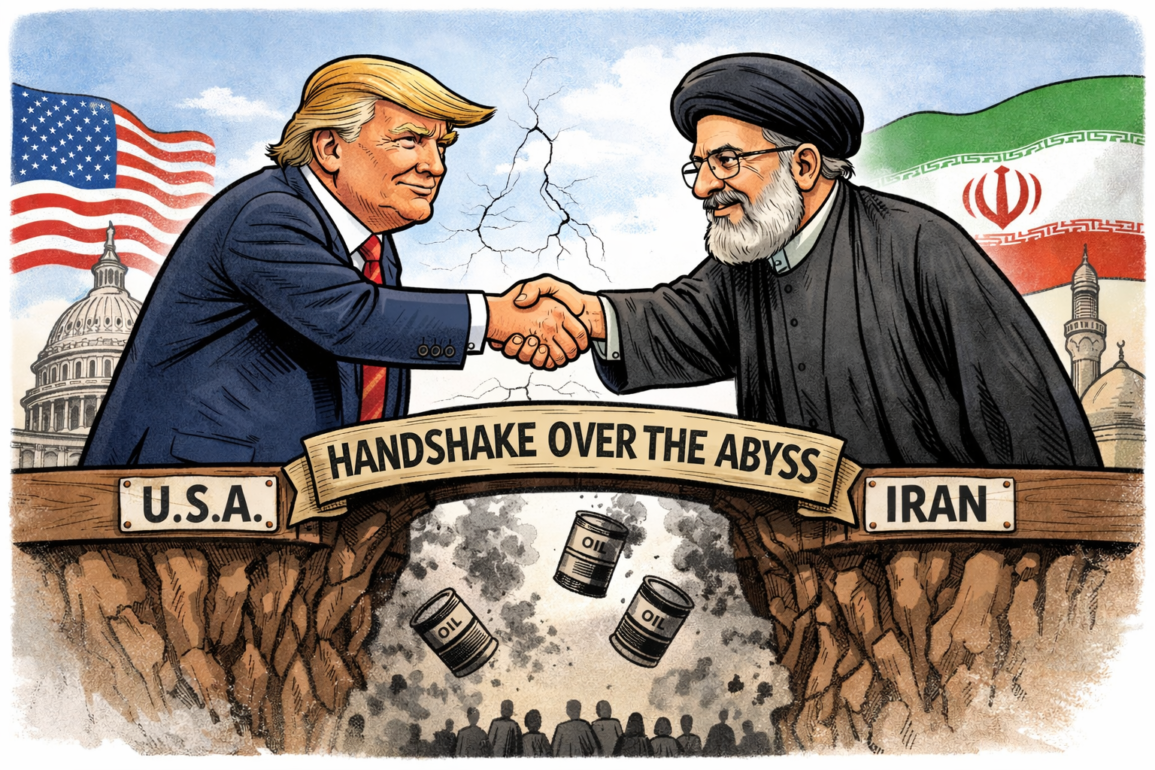

World Steps Back from the Brink as Diplomacy Prevails in U.S.–Iran Standoff
• Washington accepts Tehran’s 10-point agenda; agrees to a two-week ceasefire
By Telegraph’s Editor-in-Chief
The world exhaled on Tuesday as a fragile diplomatic breakthrough between the United States and Iran halted what had appeared, only hours earlier, to be an inexorable slide toward a wider regional war with global consequences.
After weeks of escalating hostilities and increasingly stark rhetoric—including a threat by Donald Trump to unleash overwhelming force—both sides agreed to a provisional ceasefire anchored on a 10-point framework proposed by Tehran.
The pause, though temporary, has opened a narrow but significant window for negotiations that could reshape not only regional security but also the trajectory of the global economy.
The agreement emerged at the eleventh hour, following intense backchannel diplomacy involving regional and international intermediaries. With military options reportedly primed and a deadline looming, the shift from confrontation to dialogue marked a dramatic de-escalation.
Officials familiar with the process suggest that neither Washington nor Tehran was prepared to absorb the full costs of a sustained conflict.
For the United States, a new war in the Middle East risked strategic overstretch and economic blowback. For Iran, prolonged strikes threatened critical infrastructure and internal stability.
The result was a mutual, if cautious, step back.
Observers have pointed to the convergence of diplomatic pressure and global advocacy as decisive.
Governments across multiple regions urged restraint, while international institutions warned of the humanitarian and legal implications of further escalation.
Notably, moral voices also played a role. Pope Francis, who had repeatedly called for peace in recent days, appealed for dialogue over destruction—an intervention that resonated across political and religious divides.
Peace campaigners, civil society groups, and anti-war activists amplified similar messages worldwide, shaping public discourse and reinforcing the urgency of de-escalation.
Analysts say this convergence of official and grassroots pressure helped create the conditions for compromise.
Beyond the geopolitical implications, the ceasefire carries immediate economic significance.
In recent weeks, fears of a wider conflict had sent tremors through global markets. Oil prices surged amid concerns over disruptions to supply routes, particularly the strategic Strait of Hormuz.
Inflationary pressures, already a concern in many economies, threatened to intensify.
The agreement has, at least for now, eased those anxieties.

Energy analysts say the commitment to keep vital shipping lanes open could stabilize crude prices, while the prospect of sustained negotiations may reduce volatility.
Governments, especially in import-dependent economies, will be watching closely for signs that the reprieve holds.
Despite the optimism, officials caution that the path ahead remains uncertain. The ceasefire is limited in scope and duration, and key issues—ranging from sanctions to regional security arrangements—remain unresolved.
Yet, even a temporary pause is being viewed as a critical opportunity.
Diplomats say the coming days will test whether both sides can translate tactical restraint into a broader settlement. Much will depend on trust-building measures and the willingness to make incremental concessions.
For now, the world is left to reflect on how close it came to a potentially devastating conflict—and how it was, at least temporarily, avoided.
The episode underscores a familiar but often overlooked truth: that even in moments of heightened tension, diplomacy retains the capacity to alter outcomes.
It is a lesson likely to resonate far beyond the current crisis.
As negotiations continue, the hope—shared by governments, markets, and ordinary citizens alike—is that this fragile opening can be sustained, and that the forces which pulled the world back from the brink can carry it toward a more durable peace.