


Presidential Election Petition: Supreme Court Begins Sitting Monday
By PHC Telegraph

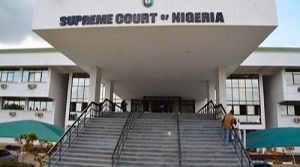
Hearing in the matter brought before the Supreme Court by the Presidential candidate of the Peoples Democratic Party Party, PDP, Alhaji Atiku Abubakar will begin tomorrow.
Atiku is seeking to upturn the electoral victory of President Bola Tinubu on the basis of what he says are new grounds indicating that his opponent in the 2023 general elections may have engaged in the forgery of a certificate belonging to Chicago State University, CSU.
Inspite of all the details contained in the 32-paged document filed by Atiku which will be the subject of legal arguments and interpretations at the Supreme Court, CSU has maintained that Tinubu attended the institution and graduated in flying colours.
For the records, what Atiku has before the apex court as fresh evidence was neither pleaded in course of the initial trial nor transmitted to the Supreme Court from the appellate court which heard the petition.
As the Supreme Court prepares to entertain the matter, it would be the first time in the history of electoral hearings that a plea which was not part of the originating particulars before a court of law will be tendered in its final stages.
Atiku and his lawyers insist the provisions of the Constitution which is the grundnorm far surpass the dictates of any legislation.
They also say that in the eyes of the law, the 180 days allowed for trials relating to the presidential election has no effect on the Court of Appeal, and so, should not in any way known to law prevent Atiku from introducing additional evidence at the apex court.
Precisely, Atiku and his lawyers are saying that the admission of additional evidence would prove that Tinubu was not eligible in the first place to enter the contest as the presidential candidate of the APC in the 2023 general election.
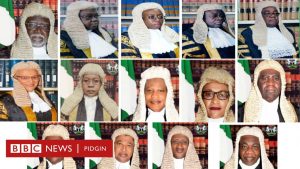 Courtesy: BBC. Faces of Justices of Nigeria’s Supreme Court.
Chief Chris Uche, SAN, counsel for Atiku said, “there is no such constitutional limit of 180 days on the lower court to hear and determine a presidential election petition, such that can rob this Honourable Court to exercise its power in any manner whatsoever”.
From all indications, Atiku would rely substantially on sections 233, 239 and 285 of the Constitution in driving his argument.
On the other hand, Tinubu, APC and INEC in separate legal positions presented at the Supreme Court argue that the provisions of the Electoral Act passed by the National Assembly and which is in force in Nigeria make it impossible for further evidence to be introduced at this stage in an election petition.
Tinubu’s reaction is incapsulated in the position peddled by Olanipekun and other lawyers representing him.
Tinubu said at one point, “Appellants’ submission under paragraph 6.45 of their brief further expose the entire attitude of the appellants before the lower court, that is, the attitude of first filing a petition and then fishing for evidence during the pendency of the petition and even up to the point of appeal to this honourable court”.

“Without prejudice to our objection to this issue”, President Tinubu noted, “we submit that the arguments regarding a purported ‘Case No. 1:23-CV05009-th Re Application of Atiku for an Order Directing Discovery from Chicago State University…’ is alien to this proceedings, does not arise from the record or the judgment of the lower court and cannot be countenanced by this honourable court.”
Against the backdrop of the provisions of the Electoral Act as amended, the 180-day period allowed by law has indeed elapsed.
Accordingly, the ‘pre-trial’ conducted in the court of public opinion after Alhaji Atiku Abubakar addressed a news conference over Tinubu’s alleged forgery of a CSU certificate now gives way to the actual hearing of a suit that is pending before a properly constituted court.
Seven Justices of the Supreme Court are to file into the Court Room on Monday to deal with the arguments placed before them.
Looking at unfolding developments, the Supreme Court will not immediately go into the merit or demerits of the judgment duly transmitted to it by the Court of Appeal.
The Court would have to resolve the legal arguments surrounding the admission of Atiku’s new evidence, possibly reserve its pronouncement and thereafter delve into the sunstantive suit.
The seven wise men may equally decide if the reference to tribunals made under the Electoral Act does not cover the Court of Appeal which is the Court of first instance in a presidential petition forwarded to the judiciary for adjudication now that the 180-day rule is being challenged.