


How America Ignored Israeli Signals for More Bloodshed at the Last Hour
By Our Staff Correspondent
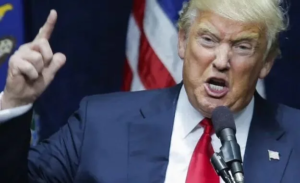
As the world held its breath in anticipation of the expiration of a self-imposed deadline by Donald Trump, events in the Middle East took a sharp and unexpected turn. Reports of Israeli strikes on Iranian-linked civilian infrastructure injected fresh uncertainty into an already volatile geopolitical moment—raising urgent questions about coordination, intent, and the limits of alliance politics.
For weeks, tensions had been building between Israel and Iran, against the backdrop of a fragile diplomatic track quietly unfolding between United States and Tehran. The emerging understanding, while still opaque in its details, signaled a possible de-escalation after months of retaliatory exchanges that had threatened to widen into a regional war.
Yet, in what many analysts now interpret as a calculated divergence, Israel appeared to press ahead with military actions that risked undermining the diplomatic window.
The strikes—reportedly targeting infrastructure with dual civilian and strategic value—echo patterns previously seen in conflicts across Gaza Strip, the West Bank, and southern Lebanon, where accusations of disproportionate force and civilian harm have been fiercely debated in international forums.
Diplomatic sources suggest that Israeli officials had, in the days leading up to the deadline, circulated intelligence assessments and target profiles they believed warranted joint U.S. action.
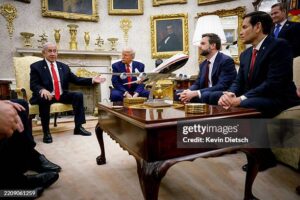 WASHINGTON, DC – APRIL 07: (L-R) Israeli Prime Minister Benjamin Netanyahu, accompanied by U.S. President Donald Trump, U.S. Vice President J.D. Vance, Secretary of State Marco Rubio, and U.S. National Security Adviser Michael Waltz, speaks during a meeting in the Oval Office of the White House on April 7, 2025 in Washington, DC. President Trump is meeting with Netanyahu to discuss ongoing efforts to release Israeli hostages from Gaza and newly imposed U.S. tariffs. (Photo by Kevin Dietsch/Getty Images)
The expectation in some quarters of Tel Aviv was that Washington, under pressure to maintain strategic alignment, might escalate rather than pivot to negotiation.
However, that escalation did not materialize.
Instead, the Trump administration appeared to double down on a narrowly defined bilateral understanding with Iran—one that notably excluded Israeli priorities and, by extension, broader regional theatres such as Lebanon. This omission has since become a focal point of tension.
Israeli officials, in public and private, have signaled dissatisfaction with what they perceive as a compartmentalized peace—one that addresses U.S.-Iran hostilities while leaving Israel exposed to unresolved security threats on multiple fronts.
The resulting disconnect has laid bare a deeper strategic divergence. For Washington, the imperative—at least in this moment—was to avert a direct confrontation with Iran that could destabilize global energy markets and trigger wider conflict. For Israel, the calculus appears more immediate and security-driven: neutralize perceived threats before diplomatic constraints take hold.
Observers note that this is not the first time U.S.-Israeli interests have diverged in moments of crisis. But the timing—at the very edge of a potential breakthrough—has amplified the stakes.

“The signals were there,” said one regional analyst. “Israel was not aligned with the pace or scope of the negotiations. The question is whether Washington chose to ignore those signals, or simply judged that the cost of following them was too high.”
There are also broader implications. By proceeding without Israeli inclusion, the United States may have reinforced a precedent: that bilateral crisis management with adversaries can, under certain conditions, supersede traditional alliance coordination. Whether this recalibration proves temporary or enduring remains to be seen.
Meanwhile, Israel’s insistence that any U.S.-Iran understanding does not extend to Lebanon suggests that flashpoints remain active. The risk of miscalculation—particularly if unilateral actions continue alongside multilateral diplomacy—remains significant.
For now, what emerged at the last hour was not the anticipated crescendo of conflict, but a fragile pause—one shaped as much by what was avoided as by what was done.
In that pause lies both relief and uncertainty, as the region—and the world—watches to see whether diplomacy can hold against the pressures pulling it apart.