


● Democrats’ fightback tests the reach of a billionaire’s chequebook
● Where the money went—and why spending cannot guarantee victory
By PHC Telegraph
At an October 23 rally at the University of Texas at Austin, hundreds of students and other supporters heard Democrat James Talarico challenge Elon Musk’s backing of Republican Ken Paxton.
“Texas is not for sale.”
That confrontation offers a human face to one of the biggest money stories of America’s 2026 midterm elections: an extraordinarily wealthy donor financing a Republican defence, while Democrats mobilised voters around affordability, accountability and who government should serve.
By October 23, WIRED’s analysis of campaign filings put Musk’s contributions to Republican political groups at more than $445 million during the election cycle. That was a dated accounting, rather than a final tally of every dollar committed or spent before polling ended.
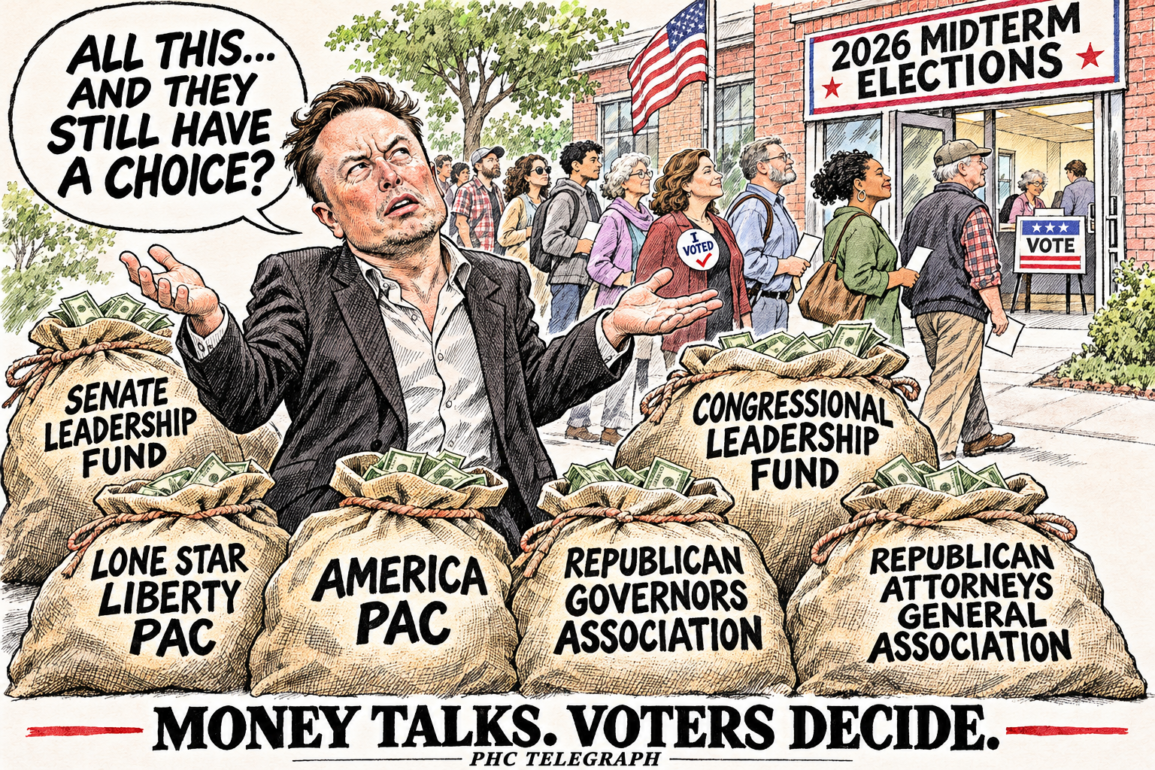
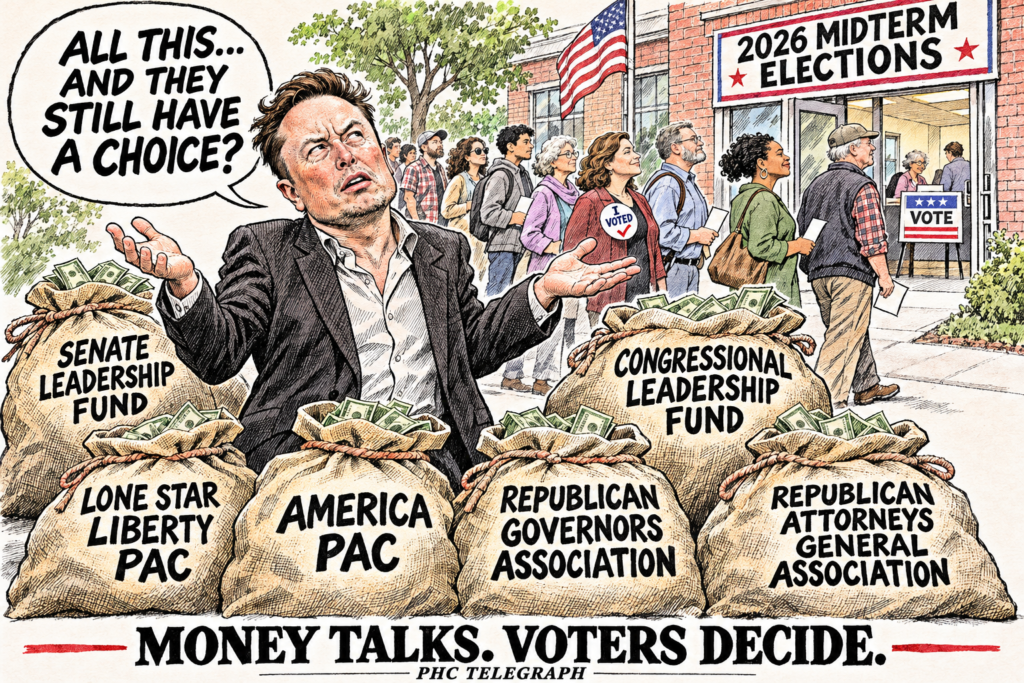
The money did not arrive as one cheque payable to the Republican Party. It flowed through organisations supporting Senate candidates, House candidates, governors, attorneys general and Musk’s own America PAC.
An October 12 Reuters report provided this snapshot of $276 million in contributions since July:
| Organisation | Contribution | Political focus |
|---|---|---|
| Senate Leadership Fund | $158 million | Republican Senate candidates |
| America PAC | $76 million | Republican campaign support |
| Congressional Leadership Fund | $20 million | Republican House candidates |
| Lone Star Liberty PAC | $10 million | Ken Paxton’s Senate campaign |
| Republican Governors Association | $10 million | Governorship campaigns |
| Republican Attorneys General Association | $2 million | Attorney-general campaigns |
| Total in this snapshot | $276 million | Part of the wider cycle total |
These figures describe an earlier portion of the same effort. They should not be added to the later $445 million-plus estimate.
Texas illustrates how the money travelled. The Texas Tribune reported that Musk gave the Senate Leadership Fund $75 million on September 9 and another $83 million two weeks later. On the day after each donation, the fund transferred an equivalent amount to Texas PAC, which supported Paxton.
Following one contribution through several organisations does not make it several separate donations by Musk. Counting the original gift, the subsequent transfer and the eventual advertisement together would exaggerate his personal contribution.
What such funding purchases is campaign capacity: advertising, voter contact and the ability to keep messages in circulation. It can help candidates answer opponents, mobilise supporters and remain competitive.
Yet the Democratic challenge had financial strength of its own.
Talarico’s campaign said it raised $64 million from July through September, with 97 per cent of donations below $100. That percentage referred to the number of donations, rather than the share of money raised.
The contrast was therefore between different fundraising networks and political messages. Democrats were financing a determined campaign themselves, alongside building enthusiasm.
Early election-night results gave that resistance substance. Roy Cooper captured a Republican-held Senate seat in North Carolina, while Jon Ossoff retained Georgia and Chris Pappas kept New Hampshire in Democratic hands. Control of Congress remained unresolved in the reports checked for this November 4 update.
In Texas, the election-night report reviewed showed Talarico leading Paxton, but the race had not been called. A developing lead could not yet be treated as a verdict on Musk’s spending.

Even where a heavily financed candidate loses, the result cannot tell us precisely how the contest would have unfolded without that support. Money may have narrowed a defeat, increased turnout or helped protect other candidates.
Equally, victory does not demonstrate that the biggest donor caused it. Party loyalty, candidate quality, local organisation and attitudes towards the president can all influence the outcome.
The Democrats’ fightback points to the limits of financial advantage. A campaign can pay to put a message before voters repeatedly; whether people believe it depends partly on their own experience.
For a household worried about prices, an advertisement cannot itself make necessities more affordable. For a voter seeking accountability, another campaign text may not settle questions about a candidate’s record.
Musk’s wider stakes include possible congressional scrutiny. In an October 23 letter, Democratic lawmakers promised closer examination of federal funding awarded to his businesses. That was a statement of oversight intentions, rather than a finding of misconduct.
His political return will depend on which candidates survive, which party controls each chamber and how much influence those outcomes give him.
For voters, the decision is more immediate: whose promises deserve their trust?
Money can equip a campaign to compete. It cannot guarantee the voter’s consent.