


Army Secretary quits after clashes with Hegseth
Military chiefs warn prolonged conflict is stretching US forces
By PHC Telegraph
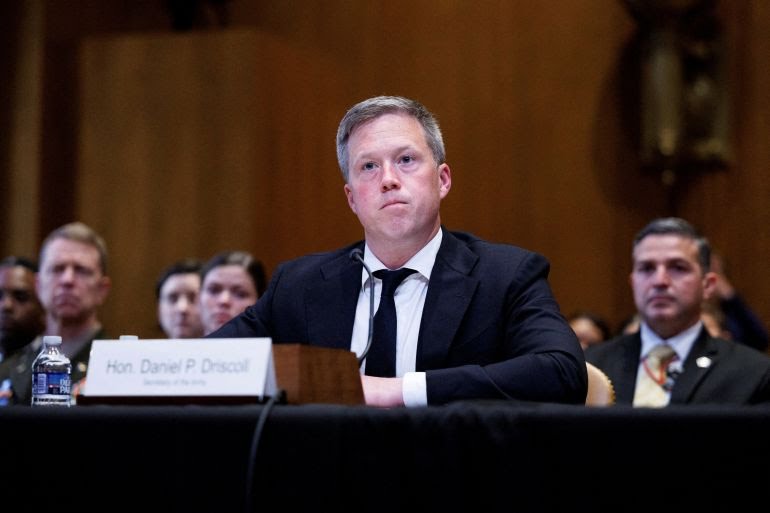
Cracks within the top hierarchy of the United States military are becoming increasingly visible as the war with Iran drags on, with Army Secretary Dan Driscoll submitting his resignation following months of reported disagreements with Defense Secretary Pete Hegseth.
The White House confirmed Driscoll’s departure Monday, bringing an end to his 18-month tenure as civilian head of the US Army.
No official reason has been given for his decision, although Reuters, the Associated Press and other American media organisations report that relations between Driscoll and Hegseth had deteriorated considerably.
Driscoll’s departure comes at an especially delicate moment for Washington. Thousands of American soldiers remain deployed in the Middle East as the US confrontation with Iran passes the six-month mark, while senior military commanders have reportedly begun warning that maintaining large-scale operations at current levels could undermine America’s ability to respond to threats elsewhere.
The resignation does not establish that Driscoll opposed President Donald Trump’s Iran policy or quit in protest against the war. Available evidence instead points to a long-running struggle with Hegseth over Army leadership, personnel decisions, military modernisation and readiness.
But the timing has inevitably drawn attention to tensions inside the Pentagon as America’s armed forces face growing operational pressures arising from the Iran conflict.
TROUBLE HAD BEEN BREWING
Relations between Driscoll and Hegseth had reportedly been strained for months.
A major turning point came in April when Hegseth abruptly removed Army Chief of Staff Gen. Randy George, who had worked closely with Driscoll on plans to transform the Army.
George’s removal apparently caught Driscoll by surprise.
Driscoll subsequently made little secret of his admiration for the ousted general, telling lawmakers that he and his family visited George after his dismissal. He described George in glowing terms and defended the contribution that the former Army chief had made to the service.
The two men had worked closely on an ambitious transformation programme designed to make America’s Army faster, technologically advanced and less dependent on extremely expensive traditional weapons.
Drawing lessons particularly from the Russia-Ukraine war, Driscoll advocated greater reliance on drones, unmanned systems and cheaper weapons that could be manufactured rapidly and deployed in large numbers.
That approach earned him a reputation as one of the Pentagon’s most aggressive advocates of military modernisation.
But some of those initiatives have subsequently been reversed.
The Army, under acting Chief of Staff Gen. Christopher LaNeve, has moved to shut down a specialised drone initiative championed by George and other commanders associated with Driscoll’s transformation programme.
Reuters reports that Driscoll raised concerns within the administration about Army transformation and readiness and believed Hegseth was obstructing those efforts by removing some of the generals responsible for implementing them.
There were personnel disputes as well.
Reports indicate that Hegseth intervened in promotion and staffing decisions that Driscoll had handled differently. Earlier this year, Driscoll also resisted pressure involving the removal of senior adviser Col. David Butler.
The disagreement apparently went beyond personalities. It increasingly became a struggle over who would shape the future direction of the Army.
FROM ‘I’M NOT LEAVING’ TO RESIGNATION
The dramatic nature of Driscoll’s exit is underscored by what he said only months ago.
As speculation about his future mounted following George’s removal in April, Driscoll publicly declared that he had no intention of quitting.
“I have no plans to depart or resign as the Secretary of the Army,” he said at the time.
He enjoyed influential political support.
Driscoll is a close friend and former associate of Vice President JD Vance and was reportedly highly regarded in parts of the White House and Congress.
Several Republican lawmakers publicly praised his performance when his differences with Hegseth surfaced earlier in the year. House Appropriations Committee Chairman Tom Cole described him as potentially a “transformational leader” for the Army.
Yet, barely five months after insisting he was staying, Driscoll has handed his resignation to Trump.
IRAN WAR ADDS PRESSURE
His departure comes as a separate and potentially more serious argument develops over America’s continued military commitment against Iran.
Senior American military commanders have warned Hegseth that prolonged large-scale operations in the Middle East risk weakening US capabilities in other parts of the world, according to a recent classified military assessment reported by The Washington Post.
Commanders responsible for operations in Europe, Asia and Latin America have raised concerns about ships, aircraft and surveillance equipment being diverted to support operations against Iran.
Some commanders formally disagreed with proposals to continue extending deployments, although they remain obliged to carry out the orders.
The strain appears particularly severe within the US Navy.
According to the report, barely one-quarter of America’s destroyer fleet is presently ready for deployment, while prolonged operations threaten to create further problems with ship maintenance and future fleet availability.
The Army is feeling the pressure too.
About 2,000 soldiers from the elite 82nd Airborne Division, mobilised earlier in the conflict, are expected to remain in the Middle East at least through September, while units operating Patriot missile-defence systems also face extended deployments.
The warning from commanders is significant because American forces must simultaneously maintain deterrence against potential adversaries in Europe and the Indo-Pacific while defending US interests elsewhere.
A prolonged concentration of military assets around Iran therefore carries consequences far beyond the Middle East.
TRUMP, HEGSETH AND THE MUNITIONS QUESTION
There are indications that President Trump himself has become concerned about the strain on American weapons stocks.
The Washington Post reported in August that Trump confronted Hegseth at Camp David over serious munitions shortages arising from the Iran conflict, demanding explanations about why weapons stocks had become so depleted.
The shortages could restrict some of Washington’s military options if the confrontation with Tehran continues or another crisis erupts elsewhere.
This puts the debate over military readiness — one of the issues associated with Driscoll’s differences with Hegseth — into sharper focus.
ARMY LEADERSHIP VACUUM
Driscoll’s resignation creates another immediate problem.
The US Army could now find itself without either of its two normal Senate-confirmed leaders.
Hegseth removed Gen. George as Army chief of staff in April, and Gen. Christopher LaNeve has since been serving in an acting capacity. No permanent successor has yet been confirmed.
With Driscoll leaving, the civilian side of the Army’s leadership will also be thrown into transition.
That leadership vacuum comes while American soldiers are actively deployed in a major Middle Eastern conflict.
Driscoll is also not the first senior official to leave amid turbulence at Hegseth’s Pentagon. The administration has witnessed a succession of dismissals, retirements and departures involving senior civilian and uniformed officials.
Navy Secretary John Phelan left earlier in the Iran conflict, while senior Army commanders including George and the former commander of US Army forces in Europe and Africa, Gen. Christopher Donahue, have also departed.
QUESTIONS FOR WASHINGTON
For now, there is no evidence of an organised revolt by America’s military leadership against the Iran war.
Nor is there evidence that Driscoll resigned because he opposed military action against Tehran.
But several developments are converging.
A respected Army secretary has quit after prolonged clashes with the Defence Secretary. The Army’s chief of staff was removed months earlier. Senior commanders are warning that prolonged operations against Iran are stretching American military resources. Weapons inventories are under pressure. And the world’s most powerful military is being forced to balance a major Middle Eastern conflict against its obligations in Europe, Asia and elsewhere.
The White House has nevertheless praised Driscoll’s record.
White House spokeswoman Anna Kelly said the outgoing Army Secretary had been “highly effective” in advancing Trump’s agenda, citing his leadership during major military operations, his emphasis on readiness and his involvement in efforts to negotiate an end to the Russia-Ukraine war.
That praise leaves an intriguing question.
If Washington believes Driscoll performed so effectively, why has a man once viewed as a rising star of the Trump administration chosen to walk away while the United States is at war?
The answer may eventually reveal considerably more about the struggle taking place behind the walls of the Pentagon — and about how long America’s military establishment believes the present level of confrontation with Iran can be sustained.